
Housing Accelerator Fund Action Plan Implementation Framework
Please note that Council voted unanimously in favour of adopting the new Municipal Planning Documents on May 13th, following the Public Hearing. The planning documents will now be sent to the Province for final review before being adopted.
May 13, 2026 Council Meeting - Public Hearing and Second Reading
March 16, 2026 Council Meeting - First Reading
December 16, 2025 Council meeting.
December 3, 2025 Council meeting.
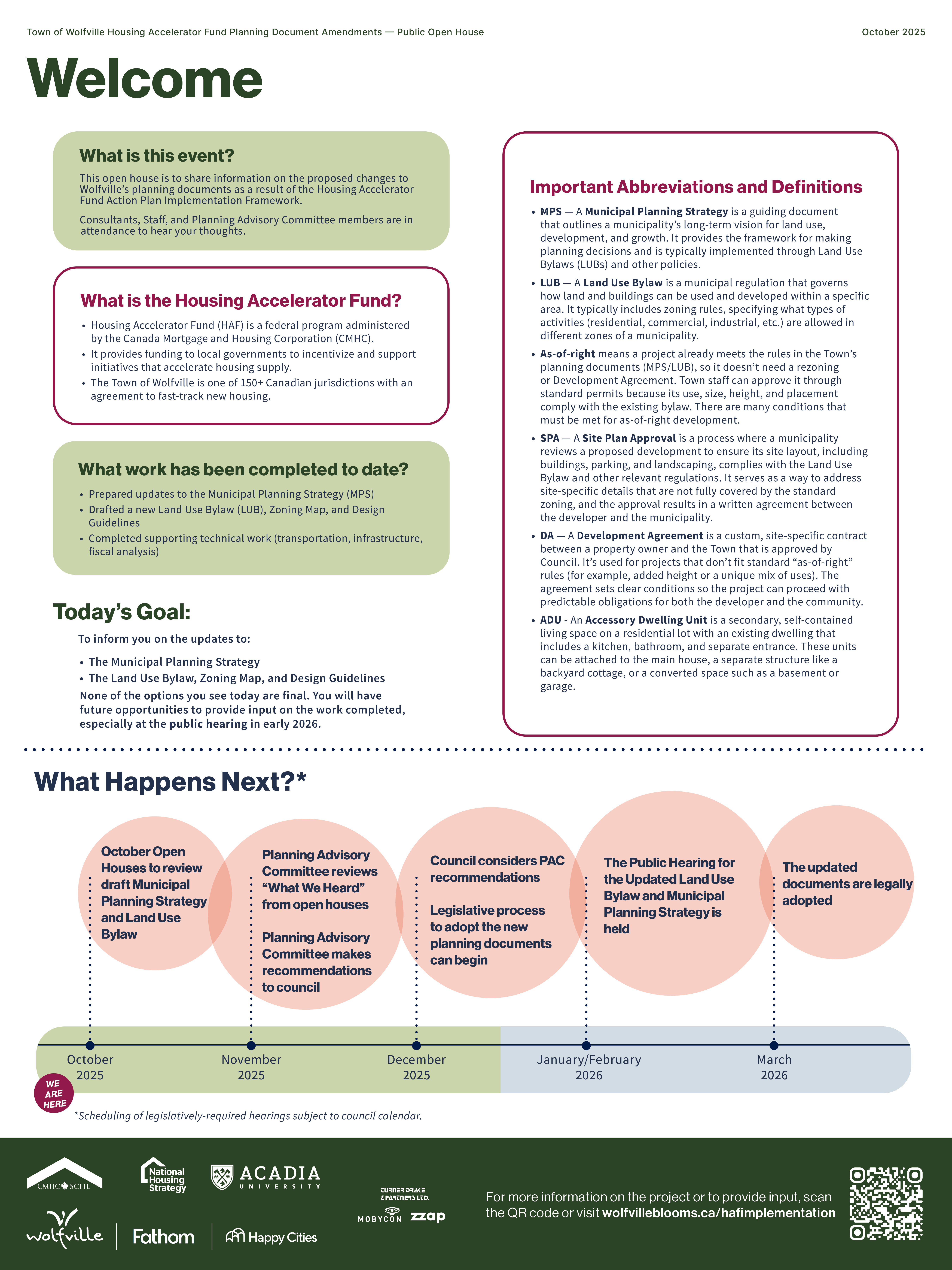
Following the Public Hearing, Second Reading of the Municipal Planning Documents occurred on May 13th, where Council voted unanimously to adopt the proposed Municipal Planning Documents. Thank you to all of those who attended and/or provided public input during this process. Next Steps: The final minor revisions are being made to the documents, and will be submitted to the Province for review prior to being implemented. This process takes between 30-60 days. The Council report can be viewed here, and the presentation slides from May 13th Public Hearing is linked on the right. Previous steps: Council gave First Reading of the Municipal Planning Documents on March 16th 2026. View the meeting agenda here The Public Hearing will be advertised for a minimum of two weeks in the local newspaper. Letters have been sent to all property owners in Town, and the event is advertised on www.wolfville.ca/events The purpose of this meeting is to provide an opportunity for the public to share their opinions on the subject matter to Council. The above noted meeting is open to the public and you are encouraged to attend and provide input. Immediately following the Public Hearing, Council will give the Planning Documents Second Reading and make a decision to adopt the documents. Following Council's adoption, the Planning Documents will be reviewed by the Province. Once Provincial review is complete, the Planning Documents are in effect. |
The Action Plan Implementation Framework has been created to support the implementation of Wolfville's Housing Accelerator Fund Action Plan.
What is the Housing Accelerator Fund?
The Housing Accelerator Fund (HAF) is a federal program administered by the Canada Mortgage and Housing Corporation (CMHC). It provides funding to local governments to incentivize and support initiatives that accelerate housing supply. The Town of Wolfville is one of 150+ municipalities participating in the program and implementing an HAF-Action Plan.
The Town of Wolfville, like many communities across Nova Scotia and Canada, is experiencing a period of change. A growing population, an increasing demand for housing, and shifting demographics create both new opportunities and complex challenges. As we plan for the future, we are guided by a central question: how can we enable thoughtful growth that meets the needs of our residents—both current and future—while preserving what makes Wolfville a special place to live and visit.
To do this work, the Town is using the Housing Accelerator Fund (HAF) as a tool to support more inclusive development to meet the diverse housing needs of families, young professionals, seniors, and students.
Through our Housing Accelerator Agreement, the Town is considering an Action Plan that includes revising parking requirements, reducing development barriers, promoting non-market housing, and allowing more than one housing unit in traditionally low-density zones. This Action Plan has been informed by residents, advisory committees, professionals, community partners and in the months ahead, they will be formalized through new Municipal Planning Documents, including the Municipal Planning Strategy and Land Use Bylaw.
Community Engagement: Public Hearing -Wednesday, May 13, 6:30PM- Wolfville Legion (310 Main Street) |
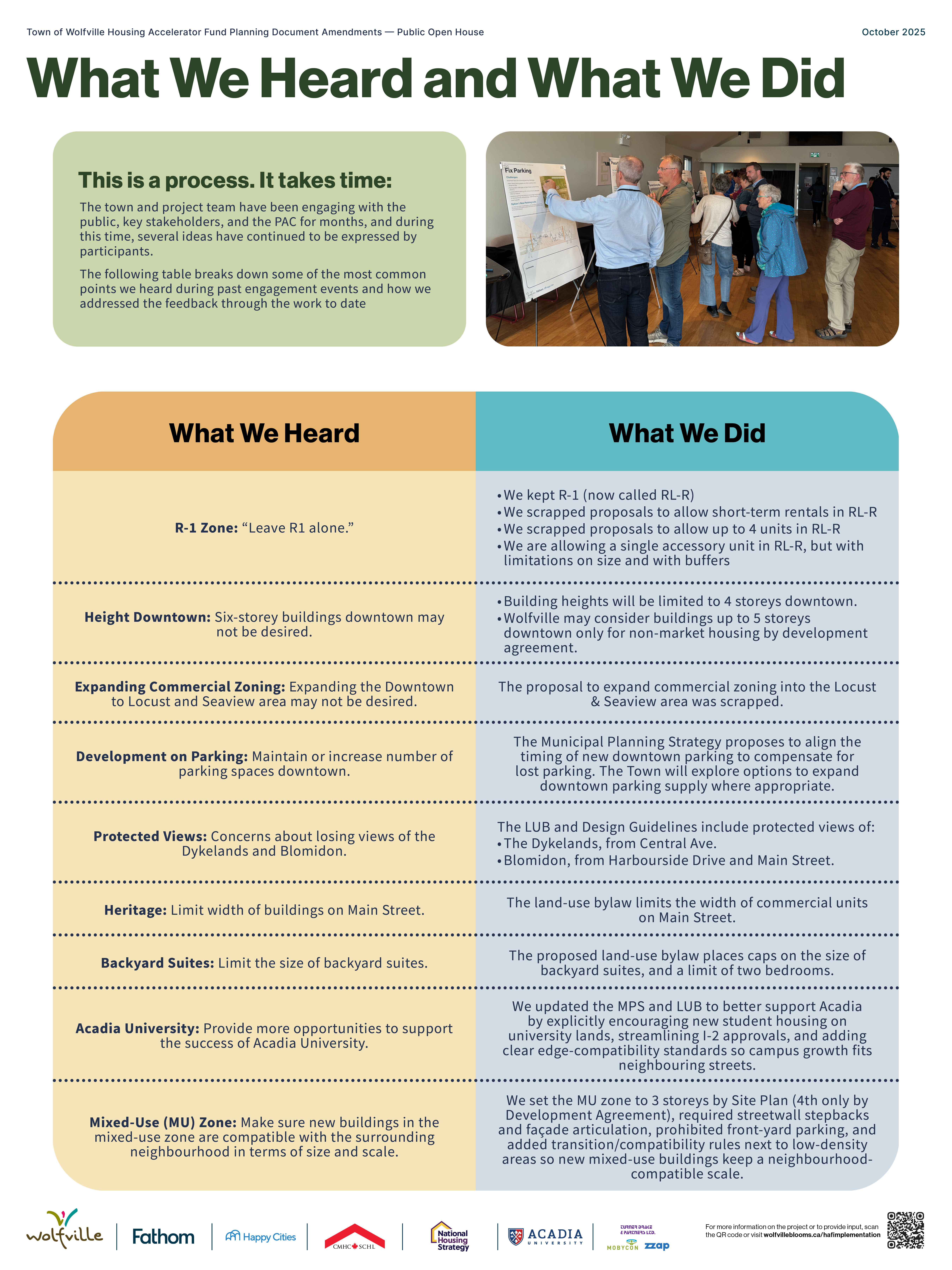
Below a small selection of the information shared at the October 2025 Open Houses is shown. To view all boards, click on the "HAF Open House Boards October 2025" on the right.
Wolfville's Housing Accelerator Fund Action Plan:
1. Reviewing and updating municipal planning documents to align with housing priorities to allow a wider mix of housing types in more areas of Town by simplifying planning processes and accelerating approvals. With changing population projections and housing needs across all demographics, updates to the Planning Documents will improve process for approving needed housing units through a gentle density approach.
This review includes:
- Amend the Land Use Bylaw and zoning map / regulations to reduce barriers to housing development by permitting more housing types as-of-right or by site plan approval. This includes replacing the Low Density Residential (R-1) Restricted zone with a zone that permits more housing types.
- Enabling gentle density through support for missing middle housing, like duplexes, townhomes, and small apartment buildings.
- Expediting housing applications and waiving development fees to support housing development.
- Conducting a Secondary Planning Process for the rail corridor lands to enable more development potential on lands within the downtown, while preserving the Harvest Moon Trail system.
2. Reviewing parking requirements to support housing viability, especially in walkable, serviced areas and the downtown. Minimum parking requirements can create a hindrance to commercial and residential development.
- Complete a parking study to understand potential paths forward to reducing parking requirements in key areas.
- Amend requirements for parking in strategic areas in an effort to reduce the cost burden of minimum parking standards as required in the current Land Use Bylaw, and opening more opportunities for commercial development in the downtown.
3. Encouraging and protecting non-market housing. Non-market housing includes cooperative housing, housing run by non-profit organizations focused on affordable housing, or provincial owned and subsidized housing. These types of housing offer permanently affordable housing options for low- and moderate-income households.
- A Non-Market Housing Strategy will be created to support the retention of existing units, acquisition of housing by the non-market sector, and encourage the development of more non-market dwelling units. This Strategy will be informed by the Housing Needs Assessment, Non-Market Housing Working Group and Community Profile.
- Key aspects of this work will include a Land Bank of Town owned land to be considered for non-market housing use, a Non-Market Grant program to provide financial support to non-market housing providers, and highest and best use analysis for town owned lands for the use of non-market housing to support with pre-development costs.
4. Partnering with Acadia University to explore student housing solutions that relieve pressure on the broader rental market and provide students with safe, suitable housing options.
- Complete a Secondary Planning Strategy for the Town and Acadia University to identify and enable opportunities for residential development on the south-east campus (the lands near Crowell Tower).
The Action Plan Framework, linked to the right, describes different scenarios for implementing the Action Plan. These scenarios are presented in order to obtain community feedback on which scenarios are most palatable. A similar approach is taken for exploring options to improve the downtown, with ideas presented for feedback and exploration.
-
 Public Hearing and Second Reading Presentation Slides - May 13 2026 (4.71 MB) (pdf)
-
 Draft Documents
-
HAF Open House Boards October 2025 (58.1 MB) (pdf)
-
Draft Documents (as of October 2025)
-
DRAFT Design Guidelines October 2025 (27.1 MB) (pdf)
-
DRAFT Municipal Planning Strategy - October 2025 (70 MB) (pdf)
-
DRAFT Zoning Map October 2025 (2.41 MB) (pdf)
-
DRAFT Land Use Bylaw October 2025 (32.5 MB) (pdf)
-
HAF Action Plan Implementation Framework - Package 3 (14.4 MB) (pdf)
-
HAF Implementation Framework Package 3 - Acadia Chapter (4.56 MB) (pdf)
-
-
Supporting Documents and Studies
-
Reports and Committee Reports
-
March 16 Council Report RFD 022-2026 Plan Review and HAF Implementation-March16-2026.pdf (3.9 MB) (pdf)
-
PAC Agenda July 2025.pdf (18.4 MB) (pdf)
-
Next Steps - HAF and Plan Review (647 KB) (pdf)
-
PAC Presentation July 2025 HAF recommendations.pdf (3.56 MB) (pdf)
-
PAC Committee Agenda - May 2025 (15.7 MB) (pdf)
-
PAC Staff Presentation September 2025.pdf (5.54 MB) (pdf)
-
PAC Committee Agenda - June 12 2025 (38.5 MB) (pdf)
-
PAC Package October 2025 (134 MB) (pdf)
-
-
Public Engagement
-
Previous Work

